The True Cost of "Free": Why DIY Website Builders Fall Short for Growing Businesses
Wix, Squarespace, and GoDaddy make building a website look easy and cheap. But for growing service businesses, the hidden costs — in speed, SEO, time, and control — add up fast. Here's what you're really giving up.
At first glance, DIY website builders like Wix, Squarespace, GoDaddy, or Weebly look like a dream. Low monthly fees, drag-and-drop simplicity, and no developer required. For a business just getting started, the appeal is obvious.
But here's what those glossy marketing pages don't tell you: the "free" or cheap plan has a price — you just pay it differently. In lost customers. In wasted hours. In Google rankings that never materialize. In a platform you don't own and can't escape.
If your business is serious about growth, here's what you're really signing up for.
Speed & Modern Tech: What You Build vs. What You Get
Website speed isn't just a technical nicety — it's a direct ranking factor in Google and a massive driver of whether visitors stay or bounce. Google's own data shows that as page load time goes from 1 to 3 seconds, the probability of a mobile visitor bouncing increases by 32%. Push past 5 seconds and that number climbs to 90%.
DIY builders are notorious for bloated code. Every drag-and-drop element adds layers of unused JavaScript, oversized images, and redundant CSS that your browser has to download and process before the page appears. Squarespace sites regularly score in the 30–50 range on Google's PageSpeed Insights. Wix has improved over the years but still lags behind custom-built sites.
A professionally built website is engineered from the ground up for performance. Clean code, properly optimized images, lazy loading, and modern build tools mean your site loads in under a second — not three. That speed translates directly into:
- Lower bounce rates — visitors who actually see your content
- Better Core Web Vitals scores — a confirmed Google ranking factor
- More conversions — faster sites convert at measurably higher rates
DIY builders also lock you into their tech stack. You can't swap hosting providers, upgrade your server, or implement advanced caching strategies. You get what they give you — and what they give you is designed to be "good enough" for millions of generic users, not optimized for your specific business.
Time Ecosystem: The Opportunity Cost Nobody Counts
Let's be honest about the time math here.
The "free" builder promises you can build a site in a weekend. Maybe that's true for a placeholder page. But a real business website — with multiple service pages, a contact form that works, SEO-friendly structure, properly sized and formatted images, and compelling copy — takes serious time. Business owners who go the DIY route typically spend 20–60 hours building the initial site.
Then comes the ongoing tax:
- Troubleshooting the drag-and-drop editor when something breaks
- Hunting for the setting that controls mobile layout
- Resizing images manually because the builder stretched them
- Figuring out why your contact form stopped working
- Researching why Google still hasn't indexed your new page
As a service business owner in Warsaw, IN, your time has real dollar value. If you bill $75/hour as a plumber or HVAC tech, every hour you spend wrestling with Squarespace's image gallery is $75 not earned. Forty hours building a site is $3,000 of lost revenue — before you've served a single customer.
A professional handles all of this for you. You show up, give input, and get a finished site. Then you go back to the thing that actually makes you money.
The smarter investment is knowing which work to keep and which work to hand off. Building websites is our specialty; running your trade or service is yours. See our website pricing FAQ for a realistic look at what professional web development costs — and how quickly it pays for itself.
SEO: The Difference Between Being Found and Being Invisible
This is where DIY builders hurt the most, and where the damage is the hardest to see until it's too late.
Search engine optimization is not just about adding keywords to your page. Modern SEO is a technical discipline that touches site architecture, page speed, structured data (schema markup), internal linking, mobile usability, Core Web Vitals, crawlability, and dozens of other signals. DIY builders fall short in almost every category:
Structural limitations. Most builders use JavaScript-heavy rendering that search engine crawlers struggle with. They generate messy URL structures, don't allow full control over robots.txt and sitemap.xml, and make it difficult or impossible to implement proper canonical tags.
Schema markup is either absent or generic. For local service businesses, schema markup like LocalBusiness, Service, and Review schema tells Google exactly who you are and what you do — and helps you appear in rich results. Builders either ignore this entirely or offer watered-down implementations.
You can't fully control your technical SEO. Title tags, meta descriptions, heading hierarchy, page speed optimization, structured data injection — these are all constrained by what the builder allows. When Google releases an update that requires a technical fix, you're waiting for Wix to push a platform update. A custom site can be fixed immediately.
Local SEO demands precision. For Warsaw, IN businesses targeting local customers, local SEO signals — consistent NAP (Name, Address, Phone) data, location-specific landing pages, geo-targeted content, and a properly linked Google Business Profile — are critical. These strategies require hands-on implementation that builder platforms simply can't support at the level a growing business needs.
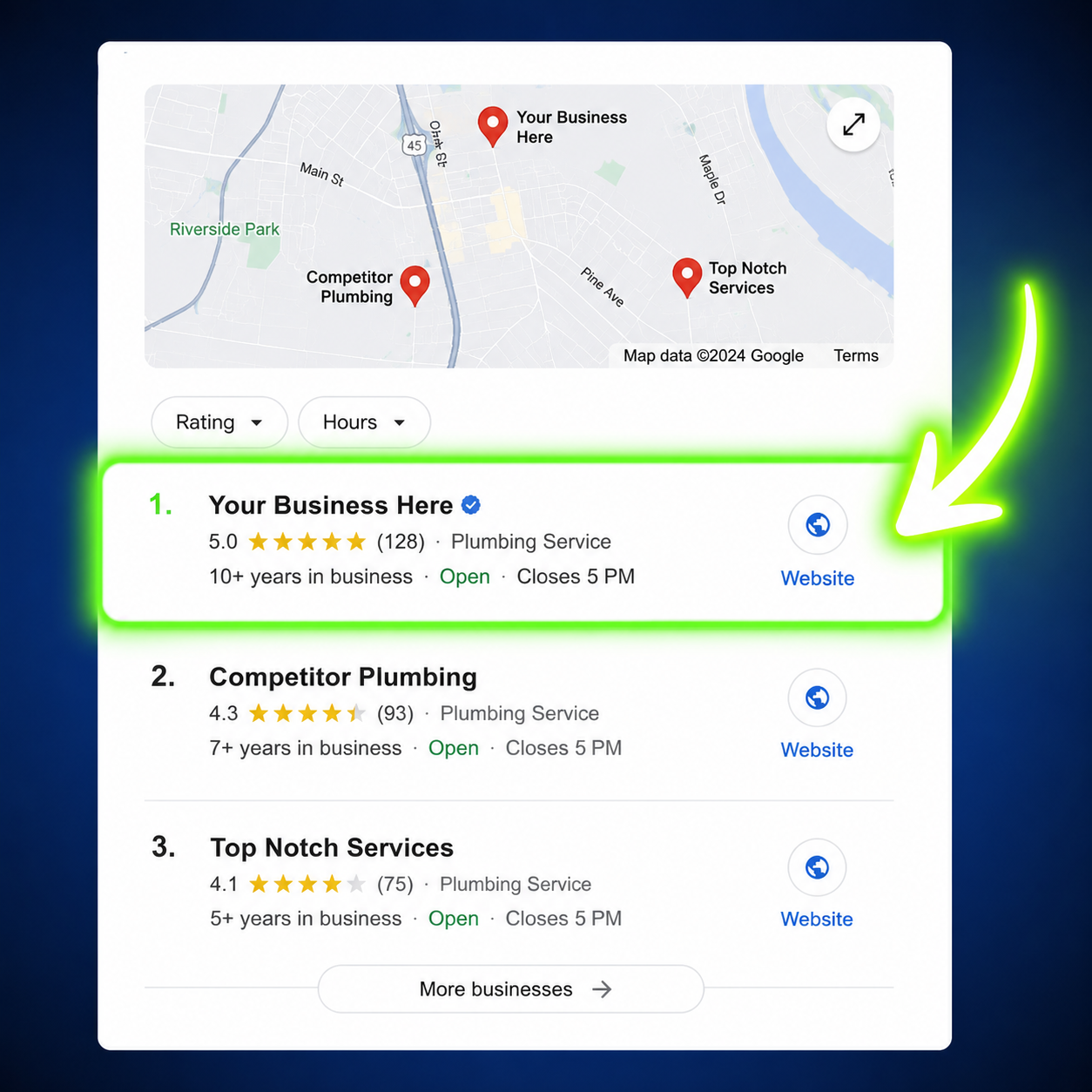
The result? Your competitor down the street with a professionally built and SEO-optimized site shows up at the top of the Google Map Pack. You don't. That's not bad luck — it's a predictable outcome of using the wrong tool.
Every month your site underperforms on Google is a month of potential customers you're not capturing. Content strategy and SEO-optimized pages build compounding value over time — but only if the technical foundation is solid enough to let Google reward the work.
Ownership vs. Renting: Who Actually Controls Your Website
This one is the most underappreciated problem with DIY builders, and arguably the most dangerous long-term.
When you build on Wix, Squarespace, or GoDaddy's Website Builder, you do not own your website. You are renting space on their platform under their terms.
What that means in practice:
- They can change their pricing. Squarespace has raised prices multiple times. If you don't like it, your options are limited — because your content, images, and site structure are locked into their proprietary system.
- They can change their features or deprecate tools. Apps and integrations you rely on can disappear with little warning.
- If you want to leave, you start over. Unlike a custom-built site where you own the codebase and files, a Wix site cannot be exported and hosted elsewhere. You leave, you rebuild from scratch.
- Your data lives on their infrastructure. Backups, uptime, and security are on their terms — not yours.
A professionally built website — especially one with managed hosting included — means you own the code, the content, and the domain. Your data is backed up daily. If you ever want to change hosting providers, the files go with you. You have full administrative access to every setting.
Owning your website also means you can scale it. Add new service pages targeting additional keywords. Integrate with CRM tools. Build location-specific landing pages. Run split tests. These are things that a rented builder platform will always make difficult, expensive, or impossible.
Your website is the hub of your entire digital marketing ecosystem. Social media posts, Google ads, email campaigns, and word-of-mouth referrals all funnel back to it. Building that hub on a rented platform is like running your business out of someone else's storefront.
The Real Math
Here's a comparison that puts it in perspective:
A typical DIY builder plan runs $16–$50/month with premium features — call it $400/year at the mid-range. Add in the 30–50 hours of time you spend building and maintaining it (conservatively valued at $50/hour) and you're at $1,900–$2,900/year — before accounting for lost revenue from slow load times, poor SEO rankings, and a site that doesn't convert.
A professionally designed website from Shilling Digital is a one-time investment that pays dividends for years. Pair it with managed hosting and maintenance and you have a hands-off system that keeps performing without your time or headache.
The question isn't whether you can afford a professional website. It's whether you can afford not to have one.
Ready to stop renting and start owning? Contact Shilling Digital for a free consultation. We build fast, SEO-optimized websites for small service businesses in Warsaw, IN — no templates, no shortcuts, no hidden fees.